Publications
The Great Haiti Humanitarian Aid Swindle
 Book Summary The Great Haiti Humanitarian Aid Swindle is the inside story of how some of the world’s most respected humanitarian aid agencies have deceived and manipulated the overseas public regarding what is really happening in Haiti. Sometimes they’ve done it knowingly, sometimes through self-delusion, but always with the goal of collecting money from sympathetic donors and always by ignoring or burying data that would contradict their fantastic claims. Their greatest ally has been the mainstream press. Thirsting for sensational stories about hunger, suffering, and violence, the world’s most prestigious news agencies—the Associated Press (AP), Agence France-Presse (AFP), Reuters, CNN, CBS, The Guardian—have for decades uncritically repeated anything NGOs, UN agencies, or pseudo-researchers claim about Haiti. No vetting of data. No critical review. In the wake of January 2010 Haiti earthquake these exaggerations and lies erupted on a scale greater than ever before: apocalyptic disaster, machete wielding gangs with faces hidden behind bandannas battling in the streets for loot, dust covered earthquake survivors resurrected from concrete tombs, two million orphans and lost children, sexual predators and slave traders prowling the rubble-strewn slums of Port-au-Prince hunting the children down, marauding bands of armed men beating and raping women and children at will, and sprawling refugee camps infested with every kind of human affliction. The avalanche of exaggerations and outright lies precipitated a tsunami of sympathy and donations, the latter of which mostly disappeared into the coffers of aid agencies, pockets of consultants, flimflam experts, and the Haitian elite.
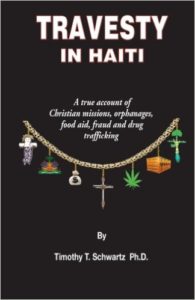
Travesty in Haiti: A true account of Christian missions, orphanages, fraud, food aid and drug trafficking
TRAVESTY is an anthropologist’s personal story of working with foreign aid agencies and discovering that fraud, greed, corruption, apathy, and political agendas permeate the industry. It is a story of failed agricultural, health and credit projects; violent struggles for control over foreign aid; corrupt orphanage owners, pastors, and missionaries; the nepotistic manipulation of research funds; economically counterproductive food aid distribution programs that undermine the Haitian agricultural economy; disastrous social engineering by foreign governments, international financial and development organizations–such as the World Bank and USAID– and the multinational corporate charities that have sprung up in their service, CARE International, Catholic Relief Services, World Vision, and the dozens of other massive charities that have programs spread across the globe, moving in response not only to disasters and need, but political agendas and economic opportunity. TRAVESTY also chronicles the lives of Haitians and describes how political disillusionment sometimes ignites explosive mob rage among peasants frustrated with the foreign aid organizations, governments and international agencies that fund them. TRAVESTY recounts how some Haitians use whatever means possible try to better their living standards, most recently drug trafficking, and in doing so explains why at the service of international narcotraffickers and Haitian money laundering elites, Haiti has become a failed State. TRAVESTY reads like a novel. It takes the reader from the bowels of foreign aid in the field; to the posh and orderly urban headquarters of charities such as CARE International; to the cold, distant heights of Capitol Hill policy planners. The journey is marked by true accounts involving violence, corruption, appalling greed, sexual exploitation, disastrous social engineering, and the inside world of drug traffickers. But TRAVESTY it is not a novel. It is founded on 15 years of academic and field experience, research, and hard data. It entertains the reader with vivid first hand accounts while treating seriously the problems inherent not only in international aid, but the sabotaging effects of the drug war on economic development in remote and impoverished areas of the hemisphere.
Fewer Men, More Babies: Sex, Family, and Fertility in Haiti
 Fewer Men, More Babies re-evaluates the debate over family patterns in the Caribbean with respect to the critical importance that child labor plays in peasant household livelihood strategies. Earlier anthropologists widely accepted and provided empirical evidence that the contributions made by children to the peasant household labor pool was a significant determinant of social patterns and high birth rates. In the 1960s researchers began to dismiss the economic utility of children. Children were conceptualized as economic burdens, wanted for emotional, religious, and cultural reasons. This ideational trend emerged in the context of changes in Western economies and corresponding shifts in ideology; it reflected agendas promoted and exported to the developing world by aid agencies; and it derailed the refinement of academic models that explain kinship and high fertility. This shortcoming is especially evident in the Caribbean.
Based on original ethnographic research, this book demonstrates how the process unfolds in contemporary rural Haiti; how intensive work regimes make children necessary; how this necessity conditions sexual behavior, gender relations, and kinship; and why, despite massive contraceptive campaigns, birth rates in rural Haiti continue to be among the highest in the world. Schwartz offers a solution to a demographic paradox that some of the most prominent sociologists and demographers of the 20th century noted but were never able to explain: among impoverished small farmers, when more men are absent due to male wage migration, the women remaining behind give birth to more, not fewer, babies.