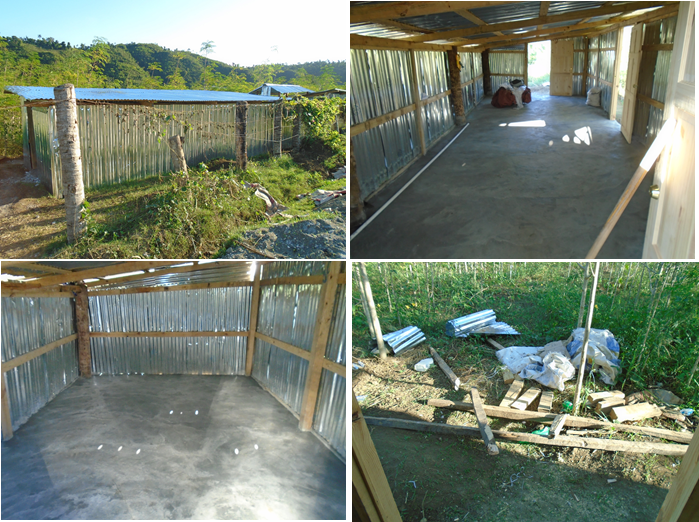
February 1st 2018, I visited a project of TTFF (Trees that Feed Foundation), founded and managed by Mary and Michael McLaughlin who claim to have breadfruit factories in Jeremie, Haiti (check their claims here). I found no evidence of them ever having produced anything. The “factory” –a tin shed valuing less than $1,000, had clearly been built in the three days before we arrived. Indeed, it was brand new (see photos). Given TTFF delays in allowing us to visit and the fact that I had reached out on behalf of WFP and HEKS EPER–which were interested in supporting the project– the likely conclusion was the TTFF “factory” had been built to impress us. The agronomist supposedly responsible for the factory admitted the factory had never been in operation and that he never had anything to do with bread fruit production. Yet, Mary and Michael McLaughlin claim that their organization, TTFF, has been productive and highly successful. They call their Haiti activities, “Lam veritab sove pep la” (Breadfruit saves the people) and write that it was Founded in 2005.
Here are their original claims, the ones that prompted me to visit in February 2018:
- Founded in and operating since 2005
- Operates/manages agriculture project with 230 farmers in Jeremie commune; farmers incorporating as cooperative
- Operates Mondrian breadfruit orchards; operates own nursery
- Partners with ZanmiSasye (ZS) in Sassier http://www.partnerswithsassier.org/
- TTFF and ZS are US based not-for-profit entities; OZGA is a Haitian based not-for-profit registered with Haitian Government
- Provides financing, technical assistance and executive management for OZGA and other organizations and Diocese of Jeremie
- …completed nearly US $2 Million in construction and infrastructure projects
Prior to my visit to the ‘factory,” I conducted an email interview with founder Michael McLaughlin. Here are my questions and Mr. McLaughlin’s responses,
Me: What is the investment needed to put someone in business: costs of equipment and manpower, etcetera?
Mike: Total costs, including shredder, dryer, grinder mill, accessories, US$10,000. This does not include a building to house a small factory. Manpower needs, first and foremost, a local entrepreneur or leader; staffing depends on workload, generally 2 to 4 people additional.
Me: How much would such a factory be producing (lbs per day, for example)
Mike: 1,000 pounds per month is typical; maximum capacity guesstimate, 4,000 pounds per month;
Me: What are the costs of making the breadfruit (for example, ‘we typically buy 100 pounds for X, it cost us Y to produce, and we get Z lbs of flour)
Mike: Hard to answer precisely but we estimate US$0.40 to 0.60 per pound including the price of the fruit and processing costs. One issue is, it’s hard to compete with free or heavily subsidized wheat flour coming from the US. (This is an example of charitable giving potentially hurting local businesses.)
Me: How quickly it can be made.
Mike: The limiting factor is the time of drying. A batch typically requires 4 to 8 hours of drying time.
Me: How long does the flour last?
Mike: Shelf life is 12 months or more.
Me: How do you typically bag it and costs of bagging it?
Mike: Manually, cost included above; bagging equipment for a commercial size facility would be a much larger investment.
After I visited the factory, I wrote Mr. McLaughlin, and told him about the experience. One year has passed since I informed him that, whatever he may think, they are producing no breadfruit flour in Jeremie. Yet, him and his wife Mary have continued making the claims and seeking donations for their “Breadfruit Saves the People” project (see their site and read some of their responses to praise and inquiries). Hence I felt an obligation to post my findings.
I will conclude by sharing the email I wrote Mike telling him what we found and the one he wrote back to me explaining the fake breadfruit factory.
From me (Timothy Schwartz) Feb 9, 2018, 7:42 AM
Mary and Mike,
I don’t know you. But judging from our exchanges, I think that guys are probably sincere.
Not sure what to say about the project I visited. Could start by saying that it doesn’t really exist. There is no production, nothing to do with breadfruit, just a lot of poorly planted moringa trees, an empty shed, and a lot of bla bla bla.
It was quite the embarrassment as I had brought with me country director of the Swiss NGO, HEKS-EPER.
Over the past 28 years I’ve seen this type of project over and over. The goal is clearly to get funding, and lastly to do anything that resembles work.
I wrote a two books about such projects. The more popular is called Travesty in Haiti. Not to promote my own work, but you may want to read it. Might help you navigate around the gatekeepers in Haiti.
Tim
Reply from Michael McLaughlin (Feb 9, 2018, 11:37 AM)
Wow.
Very sorry to hear that. Frankly I’ve had a bit of concern about the project but hoping for success. In fairness to all, we knew that breadfruit as a project was very much in the early planning stages, not a fait accompli.
Some random thoughts:
-
- As a charitable institution, we ourselves are very skeptical of most charitable efforts. We see lots of waste, lots of self serving activity, lots more talk than real help. We really try to be different by empowering local people.
- TTFF never promotes moringa not even as animal feed.
- I’ll look for your book. Another good book is “Toxic Charity.” Another “When Helping Hurts.” The wrong kinds of charity are holding Haiti back.
Could we talk by phone for a few minutes?
Mike
All that sounds good. Michael McLaughlin is a skeptic. Except it does not jibe with the fantastic claims that Michael and his wife Mary make on their website, the claims of having a successful breadfruit production project in Haiti since 2005, of having effectively spent US $2 million to promote breadfruit, of supplying some 20 Grand Anse schools regularly with breadfruit flour, of having orchards of breadfruit….
Almost humorously, Mike concluded his last email to me as such,
PS one of my favorite quotes … “When all is said and done, a lot more is said than done …”
Yes, Mike, “more said than done.” Where did the $2 million go?
For more information about TTFF and their claims contact:
TREES THAT FEED FOUNDATION
1200 Hill Road Winnetka, IL 60093
www.treesthatfeed.org
info@treesthatfeed.org